





How to Write a Eulogy in Singapore: A Compassionate, Practical Guide

Updated: May 14
Being asked to deliver a eulogy is one of the greatest honours a person can be given — and one of the most daunting. In the midst of your own grief, you are asked to find words that capture a whole life, hold the room, and give those listening something to carry with them.
This guide is written to make that task a little less overwhelming. It walks you through how to approach, write, and deliver a eulogy — not perfectly, but meaningfully.
What Is a Eulogy?
A eulogy is a spoken tribute delivered at a funeral or memorial service in honour of the person who has died. It is not an obituary — an obituary lists the facts of a life. A eulogy tells the story of a life. It captures who the person was, how they made others feel, what they stood for, and what they leave behind.
A good eulogy does not need to be long. It does not need to be polished. It needs to be true.
Who Typically Delivers a Eulogy in Singapore?
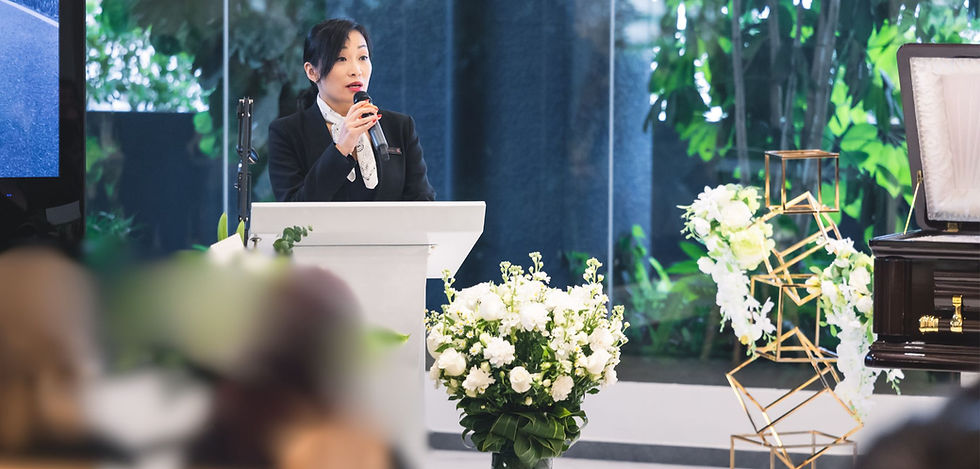
In Singapore, eulogies are most commonly delivered by a close family member — a spouse, an adult child, or a sibling — or a close friend. In some cases, a colleague or community leader may speak.
More than one eulogy may be delivered at a service. If multiple people wish to speak, coordinate in advance with the funeral director or celebrant on timing — two to three shorter eulogies often feel more natural than one very long one.
A note on religious services:
Eulogies are not always part of the formal liturgy in religious funerals. In Catholic Funeral Masses, for example, a eulogy is not typically permitted within the Mass itself, though a brief tribute may be given before or after. In Buddhist and Taoist services, eulogies may be incorporated at a designated point in the programme.
Confirm with your funeral director or religious officiant where the eulogy fits within the service structure.
Before You Write: Gather Your Material
The hardest part of writing a eulogy is not the writing — it is the gathering. Before you sit down to write, spend time collecting:
Memories — your own, and those of others. Call or message family members and close friends and ask: what is your favourite memory of them? What do you want people to know about them? What would they want said? You will find details and stories you did not know.
Their own words — letters, cards, voice messages, social media posts. The deceased's own voice, woven into the eulogy, is always powerful.
The shape of their life — not a full biography, but the moments that defined who they were. Their passions, their humour, their values, their struggles and how they faced them.
What they meant to you specifically — not just what they were like in general, but what they were to you. The particular quality you will miss most. The memory that makes you smile even now.
How to Structure a Eulogy
There is no single correct structure for a eulogy. But the following framework works well and gives the audience a clear journey through the tribute:
Opening — Begin with something that draws the room in. Not "We are gathered here today" — something personal. A memory, a quality, a line that captures the person in a single image. For example: "My father never arrived anywhere without a story to tell and a smile that made you feel like you were the most important person in the room."
Who they were — A brief portrait of the person. Not a full biography — a sense of their character, their values, their way of being in the world. What made them distinctly themselves.
Stories — Two or three specific memories or anecdotes. These are the heart of the eulogy. Specific details make a eulogy come alive — not "she was kind" but "she was the one who remembered your birthday every year and always chose the right card." Specific stories give listeners something to hold.
Their relationships — Acknowledge the people they loved and who loved them. Their family, their friendships, the communities they were part of.
Their legacy — What do they leave behind? Not only in terms of people, but values, habits, ways of seeing the world that will continue through those who loved them.
Closing — End with something that brings the room to a place of gentle completion. This might be a final memory, a quality you will carry forward, a line of poetry or scripture that meant something to them, or simply a direct farewell. It does not need to be a grand statement — it needs to feel true.
Practical Guidance for Writing
Length: Aim for five to seven minutes when read aloud. This is typically 600 to 900 words. Any longer and attention begins to drift; any shorter and it can feel incomplete. Read it aloud as you draft it — the spoken rhythm of a eulogy is very different from how it reads on the page.
Tone: A eulogy can be warm and celebratory, quietly reflective, gently humorous, or deeply moving — and often all of these at once. Follow the truth of who the person was. If they were funny, let the eulogy be a little funny. If they were private, honour that. The tone should feel like the person.
Humour: Appropriate, affectionate humour is not disrespectful — it is often one of the most loving things a eulogy can offer. A genuine laugh from the congregation is a relief and a release. But keep it gentle and be sure everyone in the room will understand the reference.
Avoid: Clichés that mean nothing — "they are in a better place now," "they would have wanted us to be happy." These are not untrue, but they are not specific to this person. Replace them with something true to them.
Write it as if speaking, not writing. Short sentences. Natural pauses. Contractions — "they were" not "they were." Read it aloud repeatedly until it sounds like you, not like a formal address.
Delivering the Eulogy
Practise. Read it aloud until you can get through it without losing your place. Practise in front of a trusted friend or family member if possible. Not to perform it — but to know it well enough that grief does not make you lose your footing.
Bring a printed copy — not notes, the full text — and hold it in both hands. This gives you something to anchor to if emotion rises.
Speak slowly. In moments of grief, adrenaline makes us speak faster than we realise. Slow down deliberately, especially at the opening.
If you cry, pause. Take a breath. Take a sip of water if it is available. The audience is with you. There is no shame in tears — it is a funeral, and tears are honest. But if you feel you may not be able to get through it, consider asking someone to be your backup — ready to step in and finish if needed.
Maintain eye contact with the room, not just the page. Look up at the end of sentences. Even a brief moment of eye contact makes those listening feel seen.
If You Cannot Deliver It Yourself
There is no obligation to deliver a eulogy personally if you do not feel you can. Options include:
Asking a trusted friend or family member to read it on your behalf
Asking TLC's Funeral Celebrant to incorporate your words and memories into the ceremony, spoken by them on your behalf
Submitting a written tribute that is read aloud by someone else
At TLC, our Funeral Celebrants are experienced in helping families craft and deliver tributes that feel deeply personal — even when the family member cannot find the words themselves.
How TLC Can Help
If you have been asked to deliver a eulogy and feel overwhelmed, speak to your TLC Funeral Celebrant. We work with families on tributes regularly — helping gather memories, shape stories, and find the words that do justice to the person who has died.
A eulogy does not need to be perfect. It needs to be honest, and given with love. That is always enough.
Call us anytime, day or night: +65 6684 8488 Or reach us via WhatsApp at +65 9126 3386
What Families Ask Us About Eulogies in Singapore
How long should a eulogy be?
Aim for five to seven minutes when read aloud — typically 600 to 900 words. Two or three shorter eulogies from different speakers often feel more natural than one very long tribute.
Can more than one person deliver a eulogy?
Yes, and it is often more meaningful when more than one person speaks. Coordinate with your funeral director or celebrant on how many tributes will be given and how long each should be.
Is it appropriate to be humorous in a eulogy?
Yes — if it reflects who the person truly was. Gentle, affectionate humour is a gift to those listening. It brings relief, warmth, and a sense of the person's personality. Keep it inclusive — avoid inside jokes that only a few people will understand.
What if I start crying and cannot continue?
Pause, breathe, and give yourself a moment. The audience is with you entirely. If you are concerned about getting through it, ask someone to be your backup — ready to step in if needed. TLC's Funeral Celebrant can also take over seamlessly if you are unable to continue.
Can TLC's Funeral Celebrant help me write the eulogy?
Yes. Our Funeral Celebrants work closely with families to help gather memories, shape stories, and craft tributes that feel authentic to the person who has died. We can help you write it, practise it, or deliver it on your behalf.
Is a eulogy appropriate at all types of funerals in Singapore?
It depends on the tradition. Eulogies are commonly included in Christian, secular, and thematic funeral services. In Catholic Funeral Masses, a eulogy is not part of the formal liturgy but may be given before or after the Mass.
In Buddhist and Taoist services, a tribute may be incorporated at a designated point. Your TLC Funeral Director will advise on the right placement within your specific service.
What should I avoid saying in a eulogy?
Avoid generic phrases that are not specific to the person — "they are in a better place," "they lived a good life." These feel hollow compared to specific memories and details. Also avoid airing family tensions, unresolved grievances, or anything the deceased would not have wished said publicly.


Comments